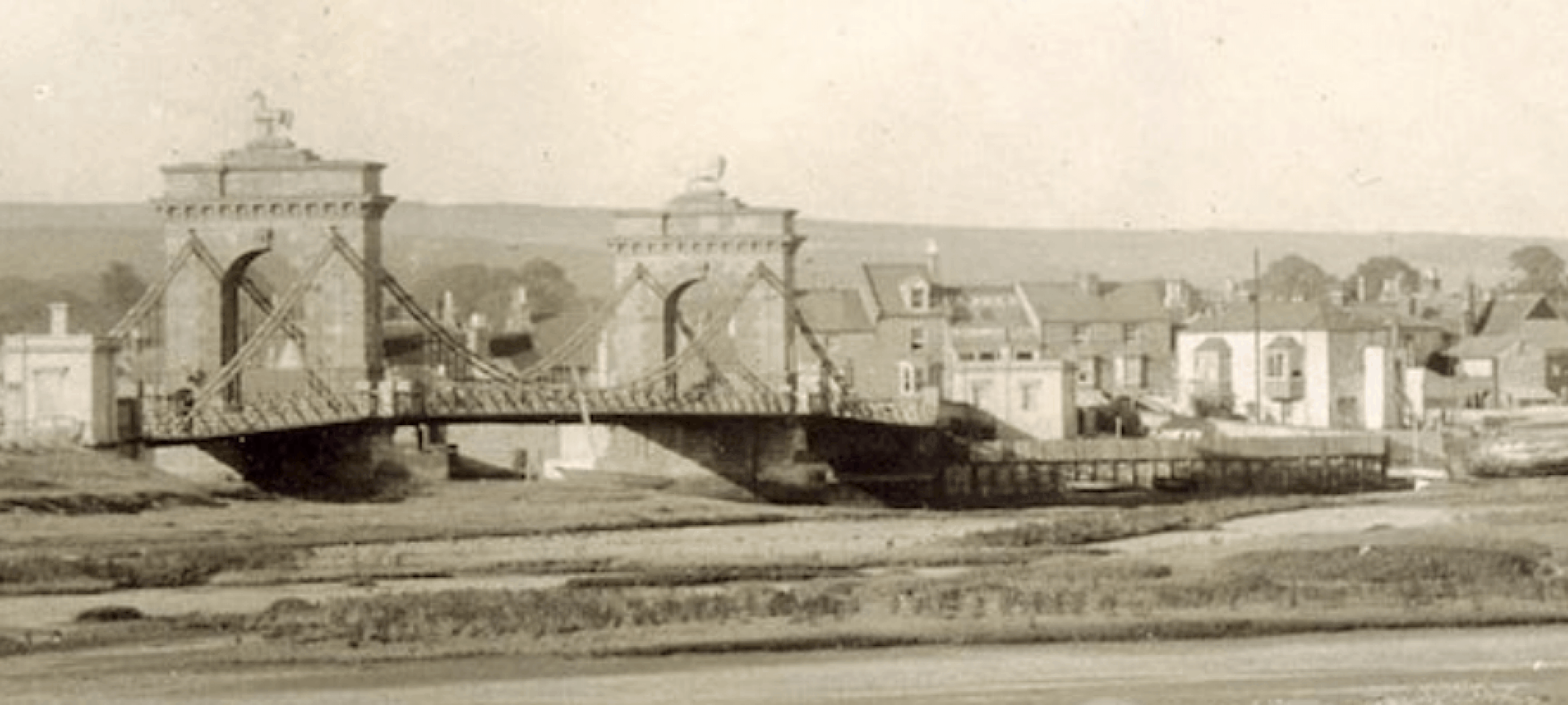

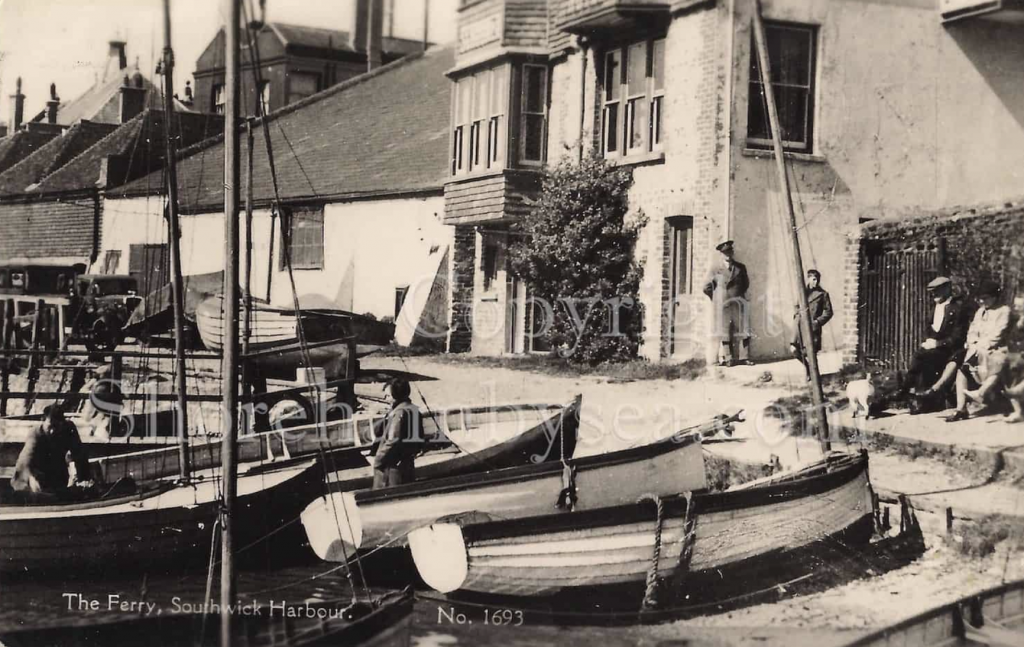
Shoreham Beach resident Gill Wright kindly allowed us to record some of her memories of when she lived in “Town” (West Street) and then when her parents moved to the “Posh part” (Old Fort Road). The lack of transport to Southwick from the east end of the Beach at the time, was resolved when a friend introduced her to “The Ferryman”.
Recorded in interview with Mike Riddiford in 2022. The recording is around 14 minutes.
Transcription:
(0:00 – 0:47)
I was born and brought up in the centre of Shoreham. My grandparents lived in the house in the road behind us. The church, youth club, school shops, dance studio, everything, it was just a short walk away. Everything was quite contained and everybody knew everybody until I was about 15. And my father had a house built down the far end of Old Fort Road. And it was lovely. We were on the foreshore. I was the envy of all my friends because that was the posh place to live at that time. Oh, you had the seaside. Absolutely. And of course, our back garden was the shingle straight into the sea. So we were, I was a very popular girl.
(0:47 – 2:05)
All my friends came over. But you weren’t in the middle of town anymore. No, and that was the problem, you see. All my friends still lived in the centre. They bumped into each other. They saw each other. It was an effort for me to get over there. My parents didn’t like me walking, especially in the evening. And it was a real pain. But they were quite good because they would give me lifts. And I had to ask for a lift. And then they’d tell me, I’ll pick you up at half past nine. I didn’t like that. But anyway, it was okay for a while until I was talking to my next door neighbour one day. And she told me about the ferryman.
The ferryman that saved my life. I used to go down to Southwick at the weekends and play tennis in Kingston Lane there, where the croquet club is and everything. Yeah, Kingston Lane. And of course, to get there, I had to walk all the way into the showroom and then go all the way along the front. So this ferryman, she took me down there one day. And there he was, over the other side, Southwick side, by the lighthouse, with his little ferry boat, just a little rowing boat.
(2:07 – 2:30) And I waved. She waved. And he got in and he rowed over. And I stepped in the boat and he rowed me back to the Southwick side. Where did the boat come on this side of the river? Somewhere near, a little bit east of the harbour club. So it was easy for him to come over.
(2:32 – 4:15)
Well, I suppose it was. He never complained. He hardly ever said anything. And all for a few pennies. It was marvellous. So he saved my life. I didn’t have to ask my parents to take me. They didn’t have to come and pick me up. I could play tennis at the weekends, or at least that’s what they thought I was doing.
Did the ferry work at night? No, no, no. I never went over to play tennis at night. And usually by then, I was 15, 16, most of the boys in the group of friends that we had, they had cars by then.
So once I had a boyfriend with a car, I didn’t even need the ferryman. No, but it was really useful. I don’t think he was regulated in any way. He wasn’t licenced. Certainly didn’t have any life jackets or anything like that. So how did you call him then? You just waved. And if he didn’t see you, you just shouted. I don’t remember having a conversation with him. And he wasn’t concerned about the tide or anything like that? No, no.
I think he was just somebody at the weekends who earned a few extra pennies, shillings, whatever. And I did think in lockdown, I’m sure, haven’t we got some enterprising fellow that would get his boat out? Richard Durrant started serving coffees and things, didn’t he? Why does nobody ever think about having a little boat? Because you don’t get the big boats coming in the harbour. They don’t go down that end, down the river end.
(4:15 – 4:20)
No. So I don’t know. It’s something to think about.
(4:20 – 6:31)
Maybe everybody’s got cars these days. Yeah. It’s a long way. I mean, we do have a bus now, every hour and 10 minutes. But you have to time everything if you want to get the bus. And it’s a long way from the fort, that end of Old Fort Road, all the way down, round and back again, if you’re going to Southwick.
Oh, yeah. Well, it’s a long way. It’s a little shortcut.
And they’ve talked for ages and ages about having a bridge there. I can’t see it ever happening. Well, these days, everybody’s got cars, haven’t they? Motorbikes and… Yeah, I suppose.
Yeah. And if they haven’t, they’ve got… A lot of people cycle now anyway, don’t they? So, yeah. Were there no buses then? There was a bus later on, and I was trying to remember how old I was.
Probably about 17 when the bus came. And in fact, it used to go down Old Fort Road to the Burroughs, you know, the big roundabout by the Burroughs. Yes, I do.
Yeah. Yeah. And that’s where the bus stop was.
And then it would just go around the roundabout and back again. So, yeah. But I can’t remember when that was.
So the Burroughs was quite a step from your house still. No, not really. No, no.
Because we were 110. So actually, we were just off the roundabout. So where did you go to school then? Went to King’s Manor, which is now Shoreham Academy.
So how did you get to there from Shoreham Beach? Very often, I got a lift in. Or we used to just walk into town and then get a bus. And it’s a bit like it is now.
There was either a bus that went along the front and then along the Brighton Road, and then you walked up Kingston Lane. Or like we have a number two now, it goes all the way around the houses and stops at the top of Kingston Lane, and you walk down. So, yeah.
(6:31 – 8:33)
Did you go to a primary school in Shoreham? Went to Victoria Road School, which is now Swiss Cottage. So, and we used to walk slightly up West Street through the Twitten. Yes, I know.
And on the corner of the Twitten, West Street side, there used to be a little grocery shop. And it was always very dark in there. I hated going in there.
But yes, so through the Twitten, then turn right and go to the top of Victoria Road, turn left, and there’s the school. It was easy peasy. Yeah, yeah.
We used to do a similar route a couple of evenings a week to Swiss Cottage, the pub, because the room on the front, on the right-hand side, that was turned over to a dance studio. Oh, really? And it wasn’t Dinky Flowers, but I can’t remember the name of the woman that ran it. But we used to do ballet, tap, Greek dancing.
And that’s in the pub, the building it is now? Yeah, yeah. You know, if you stand in front of it with your Back to Collins place sort of thing, so you’re looking at the front, that far right side, that was where we used to go for ballet. And Brownies, Brownies was up at the Good Shepherd Church.
And there was, in West Street, there was the Boys’ Club. Yeah, that was the Boys’ Club. Yeah.
I don’t know. I never went in, so I don’t know. But there seemed to be a lot of band practise.
It was almost like Salvation Army. You know, you could hear the band practise. Never any trouble.
But yes. That was primary school then? Primary school. And then for a short, yeah, then from primary school, for a short while, I went to Marlowe, but only 18 months.
(8:33 – 10:05)
And then I came back again and went to, yeah, King’s Manor. And that’s where I met Sue. So, we went through school together.
And she’s still my friend. Despite both of us having moved away and come back again. Well, she didn’t.
I think the furthest Sue moved was Brighton. I went a bit further than that. Bill was telling me yesterday about a double-decker bus that was blown off of the old wooden bridge. When he was a little lad and he lived at Holmbush Farm, you know the toll bridge? The toll bridge, yes. So, a double-decker bus actually was blown off of it in a gale. I don’t remember that. And the tide was out and nobody was hurt. They all scrambled out, OK. I don’t remember that. I can’t imagine a double-decker bus going over that wooden bridge, to be honest with you. No way, no way, no. I would like… My grandfather was a surveyor working for the council. And he always used to tell the story, or so did my father. And if you talk to my brother, he’ll probably tell you the same story. So, it’s one of these that has been handed down. Whether it’s true or not, I don’t know.
Chambers on the High Street used to be the town hall. And apparently, my grandfather had to go down one time into the sort of the cellars to check out some structural engineering.
(10:06 – 10:54)
And my father says, he went down with him one day and there are passageways under the High Street. But he said, if you go down underneath Chambers, it’s almost like a church or a cathedral. You know, it’s really tall brickwork, arches and everything.
And I’ve always wanted to go down there. But, I mean, they don’t do guided tours. It’s probably far too dangerous.
But I’m curious. Yeah. It’s a lovely building.
In all the old films of Shoreham, it’s always there. It’s the same building. A lot of it’s around it’s been rebuilt.
Yeah. Yes, if you look at the old postcards, you can pick out Chambers, like you can pick out Marlapin’s, the museum. But, yeah.
(10:55 – 13:33)
Do you remember Ropetackle before it was knocked around? I remember when there was a cinema there on the, well, it’s where the traffic lights now are on that junction there. Because my grandparents lived in Victoria Road. So, and they had an orchard at the back of their house, apples and pears and things.
But when they sold the house, the orchard was sold. And I think it was, I think there used to be a garage where the pet shop now is. And I think the garage used it just for storage of cars, which is a shame really.
But yes, because all the houses had outside loos. Yeah. My mother, well, both my mother and my grandmother, they had a range in the house.
So were any of the rooms heated? No. So you sat in the kitchen? In front of the fire. You were okay if you were in front of the fire.
But, and if you moved away, boy, somebody would take your place really, really quickly. But yes. And my grandparents, I remember there, so they had like a lean-to at the back of the house.
And that’s where my grandfather used to repair shoes. So anyone in the family, we never went to a cobbler or a shoe repairer, just give them to granddad and he used to. And so he had his last and he had leather and his tools and things out there.
But that wasn’t his profession? No. He was just a handy person? Yeah. I think most people were in those days.
It was a way of saving money. The outside loo, literally newspaper torn into squares on a piece of string, you know. Yeah, I remember.
And a wooden seat, a hole cut in a wooden plank. That’s right. Yeah.
And my grandmother had a range in the back room, but part of the lean-to, she actually had an electric cooker in there. But she used to enjoy cooking on the range and a piece of string and she’d have her stockings hanging up there, drying off. When I used to go and see my grandmother on every Monday was like washing day and she’d change the beds and then she’d do the washing.
It was like a fire under a, I don’t know what you’d call it, a cauldron thing. Yeah. And then beat it with some form of stick.
(13:33 – 14:21)
Yeah. Really hard work. Very hard work.
My mother had an old tin bath which she used to put on the range so it heated the water. Excuse me. And then of course she had to empty it again and she’d carry it out.
And in the back garden we had a mangle. And so I was able to turn the handle, but strict instructions, keep your hands out of the way of the rollers. And then the mangle was pushed back and the tin bath hung on the wall.
Yeah. But yes, that’s why they had cold meals on a Monday, isn’t it? Because there wasn’t time to do the cooking as well. Oh, I didn’t know that.
(14:21 – 14:29)
It took all day to do the washing. So was it tradition that Monday was washing day? Well, as far as I know. My grandmother did it on every Monday.
(14:29 – 14:33)
Yeah, my mother and my grandparents. Grandmothers, yeah.